Ceramics
El Carmen de Viboral ceramics
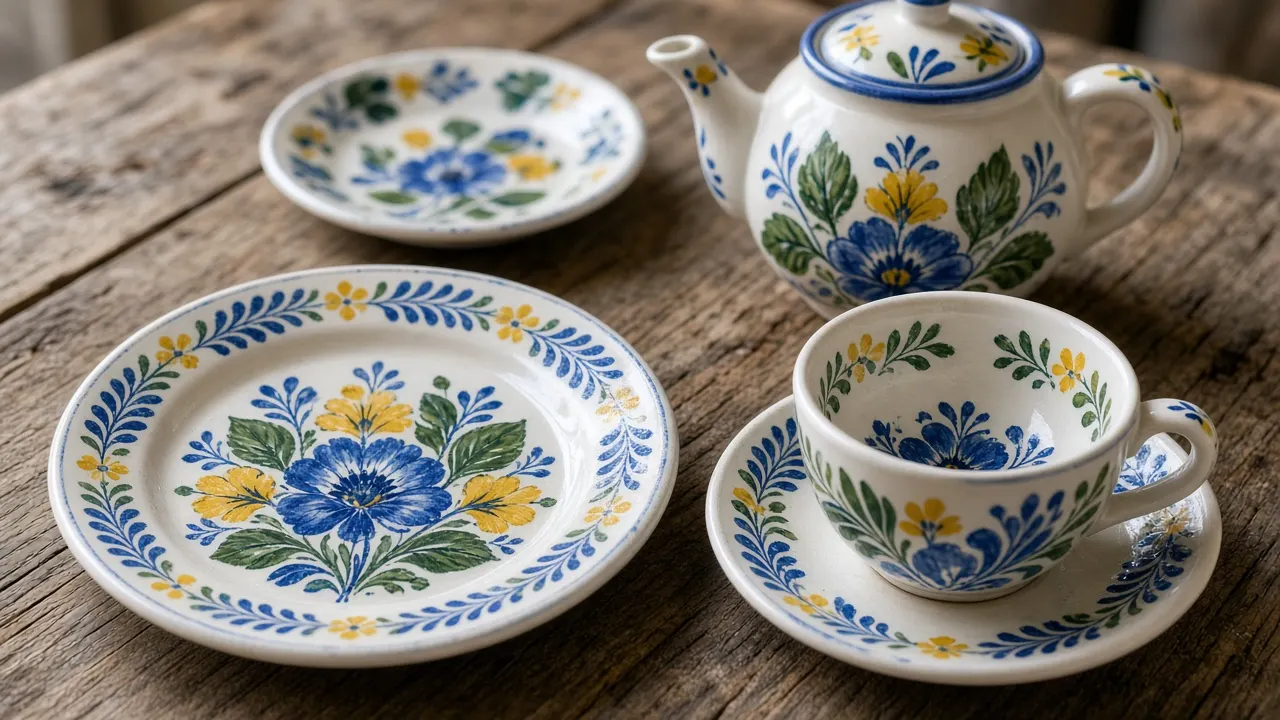
White plates with flowers painted freehand, no stencils. That is the pottery that made the town famous. Here is where to see it, how it is made and what to check before you buy a set.
Affiliate links: if you book through them we may earn a commission from Booking.com at no extra cost to you. How it works.
- 1898Eliseo Pareja arrives and the tradition starts
- 2011designation of origin (SIC)
- 2 firingsbisque and glaze
- by handevery brushstroke
A bit of history
According to Colombia's Ministry of Culture, Eliseo Pareja, a pottery businessman from the town of Caldas, settled here in 1898 and founded the Locería del Carmen the following year. Many more factories followed, such as Júpiter, Continental and Cerámicas Unidas, and between the 1930s and 1950s much of the tableware used in Colombia left El Carmen by mule or truck. Decorating was mostly women's work.
From the 1980s the industry went into crisis. Trade liberalization, competition from mechanized factories and then the armed conflict in eastern Antioquia closed nearly all the big potteries. What survived was the craft itself, in smaller workshops that now rely largely on tourism and direct sales.
How a piece is painted
Colombia's Superintendence of Industry and Commerce (SIC) has protected "Cerámica del Carmen de Viboral" as a designation of origin since Resolution 71791 of 2011. It describes the pottery like this: a white base, flower patterns made with spontaneous short, long, thick and thin brushstrokes, and two firings, one for the bisque and one for the glaze. Pieces are mostly formed by slip casting and jiggering.
In practice, two plates with the same design never come out identical. If you want matching pieces for a large set, ask the workshop about the series and look at every plate before they wrap it.
Ceramics Museum
It is run by the tourism office of the Culture Institute and reopened on December 8, 2012. Inside are plates, tureens, mugs, tools and photos of the old factories. It is at Carrera 30 # 27-66 and, according to its official page, opens Monday to Friday 2:30 to 6:00 p.m. and weekends 1:00 to 5:30 p.m., with guided tours. Note that it is closed in the morning.
Ceramics Street
The old commercial street, now covered in pottery mosaics on facades, baseboards and benches. The tourism office also promotes the Calle de las Arcillas (Clay Street), with mosaics of native trees such as the siete cueros, the yellow guayacán and the wax palm. Both are a few blocks from the main square.
Workshops open to visitors
These workshops advertise tours or hands-on sessions on their own websites. Hours and prices change, so message them before you go:
- Cerámicas Renacer: guided workshop tour, a session decorating your own plate or mug, and custom pieces.
- Cerámicas La Perla: "potter for a day", decorating a mug or shaping clay.
- A Puro Pincel (Ancestral Cerámicas): workshop at Carrera 31 # 34-70, selling hand-painted pieces.
Painting a mug takes a while, because the decorated piece is fired afterwards. Ask whether they ship it or you need to come back for it.
Tips for buying tableware
- Buy at the workshop when you can: you see the process and know where the piece comes from.
- Hold each plate up to the light and check the rim for cracks or chips. Seconds can be cheaper, but ask what the flaw is.
- Ask for travel packing. If you are flying, carry the most fragile items in your hand luggage.
- Prices depend on size, how detailed the painting is and how many pieces you buy. We do not publish prices because they vary by workshop and season.
Pair it with
Lunch near the square (where to eat) and, in December, the Fiestas de la Loza (festivals). Coming from far away? See how to get there and hotels in town.
Frequently asked questions
Where can I buy tableware in El Carmen de Viboral?
What are the Ceramics Museum opening hours?
Why does El Carmen pottery have a designation of origin?
Can I paint my own piece?
Sources
Checked on October 18, 2026. Prices and opening hours change: always confirm with the official source before you travel.
- SIC: Denominación de origen Cerámica del Carmen de Viboral
- Ministerio de Cultura: Los cuadernos del barro, El Carmen de Viboral (PDF)
- Instituto de Cultura El Carmen de Viboral: Museo de la Cerámica
- Oficina de Turismo El Carmen de Viboral
- Cerámicas Renacer
- Cerámicas La Perla
- A Puro Pincel: how a piece is painted